
a. Treatment with commonly used therapies has been associated with the emergence of atovaquone- and azithromycin-resistant B. microti. [Clearly, none of our seven books discussing dosing from 2005-2008 were examined. We beat this resistance with atovaquone “yellow paint” by using a dose far above the routine 10 mL a day, by using 20-30 mLs a day.
b. In my Babesia 2009 Update, we report human results that azithromycin has no visible effect on repeated human blood exams by an expert microbiology pathologist. Amazingly, it required 2000 mg to see any effect on human Babesia, which is the “baby in the red blood cells.”
c. Common treatments may lead to death at an unknown percentage. But Persing summarized the treatment of a small case series.
Patients had an initial parasitemia of 54% [54% of their red blood cells had Babesia inside them] and succumbed [died from]… B. duncani infection despite treatment with clindamycin, quinidine, doxycycline, pentamidine, red-cell transfusion, and hemodialysis. I have used the latter two and feel some have improved.
In recent years, the Yale team reports: Human babesiosis is a potentially fatal tick-borne disease caused by intraerythrocytic Babesia parasites. And it would be unfair to expect a frequency. [Bolds are mine].
Quinidine can have high side effects in some. And I have never needed it.
Key Finding Of Babesia Study On Tafenoquine (Arakoda) And Atovaquone Liquid
Tafenoquine and atovaquone achieve cure with no recrudescence [relapse] in both models of human babesiosis. Interestingly, elimination of B. duncani infection in animals following drug treatment also confers immunity to subsequent challenge. Altogether, the data demonstrate superior efficacy of the tafenoquine plus atovaquone combination over current therapies.
- In 2006, I promoted tafenoquine as an important future drug.
- They used the same approach as I did in 2000-2007, while writing the definitive Babesia microscopy guide with over 100 forms to ID Babesia in blood smears to evaluate the effect of various treatments.
- They report “mixed results … as a monotherapy against babesiosis….” We have never used one treatment for Babesia in 25 years and agree.
- Vydyam P, Pal AC, Renard I, Chand M, Kumari V, Gennaro JC, Mamoun CB. Tafenoquine-Atovaquone Combination Achieves Radical Cure and Confers Sterile Immunity in Experimental Models of Human Babesiosis. J Infect Dis. 2024 Jan 12;229(1):161-172. doi: 10.1093/infdis/jiad315. PMID: 38169301; PMCID: PMC10786256.
- Persing DH, Herwaldt BL, Glaser C, Lane RS, Thomford JW, Mathiesen D, Krause PJ, Phillip DF, Conrad PA. Infection with a babesia-like organism in northern California. N Engl J Med. 1995 Feb 2;332(5):298-303. doi: 10.1056/NEJM199502023320504. PMID: 7816065.
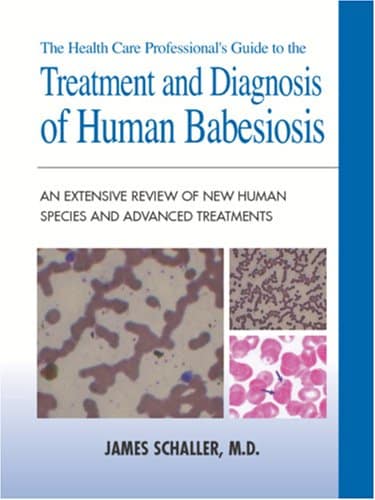
- Schaller, James. The Health Care Professional’s Guide to the Treatment and Diagnosis of Human Babesiosis: An Extensive Review of New Human Babesia Species and Advanced Treatments. Hope Academic Press. 2006.
- Schaller, James. A Laboratory Guide to Human Babesia Hematology Forms. Hope Academic Press. 2008.