In the USA, Canada, and Europe, the infectious agents that cause Lyme disease include Borrelia burgdorferi in North America and Borrelia afzelii or Borrelia garinii in Europe and Asia, respectively. [Though these species can be found in all three huge regions.] The infection affects multiple organ systems, including the skin, joints, and the nervous system.
“Brain Lyme or “Lyme neuroborreliosis (LNB) is the most dangerous manifestation of Lyme disease, occurring in 10-15% of infected individuals. [Rarely taught and this is cured with doxy 200 mg or Amoxy?] During the course of the infection, bacteria migrate through host tissues, altering the coagulation and fibrinolysis pathways and the immune response, and reaching the central nervous system (CNS) within 2 weeks of a tick bite. [Speed is debated, but the general point is useful.]
…Persistent forms of LNB are relatively common, despite targeted [targetted to four forms or merely the active form?] antibiotic therapy.
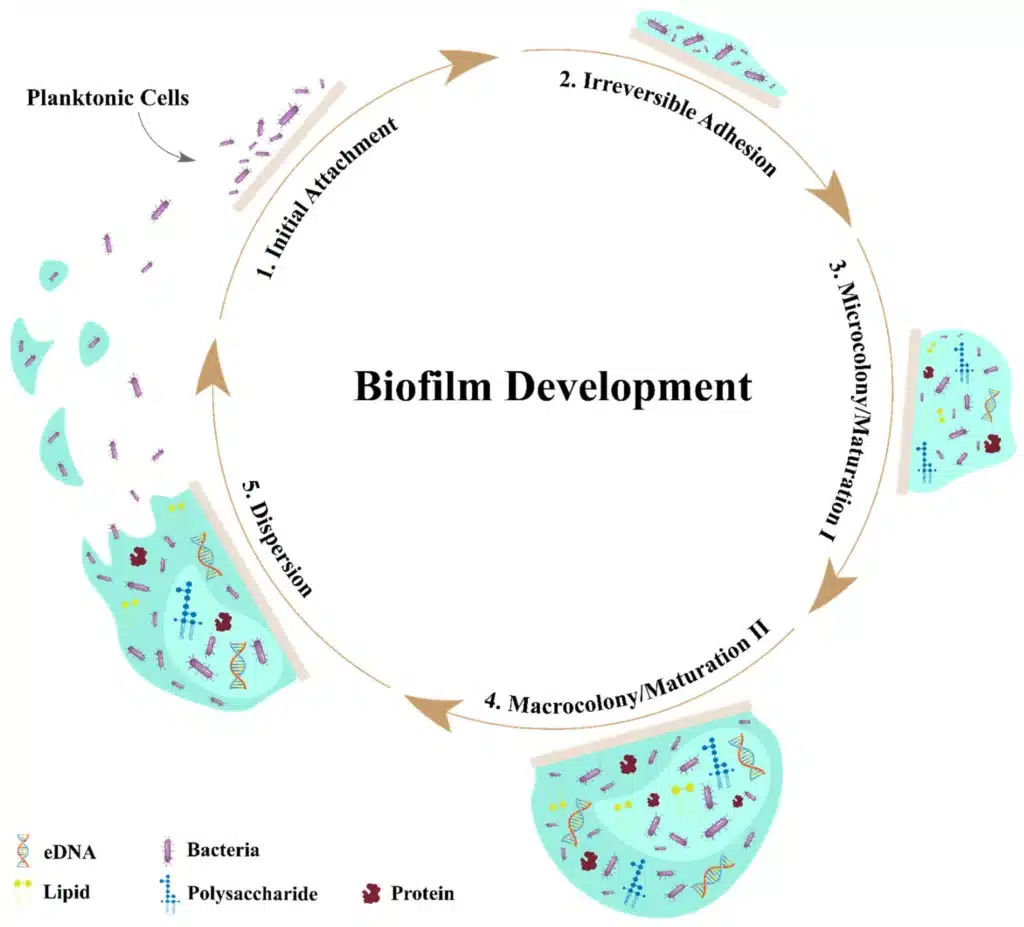
It has been observed that the antibiotic resistance and the recurrence of Lyme disease are associated with biofilm-like aggregates in B. burgdorferi, B. afzelii, and B. garinii, both in vitro and in vivo, allowing Borrelia spp. to resist to adverse environmental conditions. Indeed, the increased tolerance to antibiotics described in the persisting forms of Borrelia spp., is strongly reminiscent of biofilm-growing bacteria, suggesting a possible role of biofilm aggregates in the development of the different manifestations of Lyme disease, including LNB.
We have published options for treating this protective slime in our 2014 COMBATTING BIOFILMS. I have found ten more treatment options this month.
You never “master” Biofilms unless you feel you have mastered them in three hours of lectures or study.
Image 1. Bano, S.; Hassan, N.; Rafiq, M.; Hassan, F.; Rehman, M.; Iqbal, N.; Ali, H.; Hasan, F.; Kang, Y.-Q. Biofilms as Battlefield Armor for Bacteria against Antibiotics: Challenges and Combating Strategies. Microorganisms 2023, 11, 2595. https://doi.org/10.3390/microorganisms11102595