
Yes. Lyme disease does not simply “weaken the immune system.” Borrelia burgdorferi interacts with and alters multiple parts of innate and adaptive immunity. Some responses are strongly activated, while other responses can be diverted, suppressed, or made less effective. The result is an unusual combination of inflammation + immune evasion + incomplete clearance.
Strong Innate Immune Activation
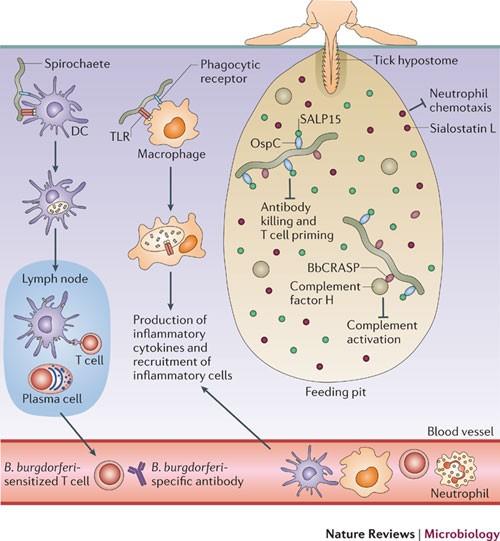
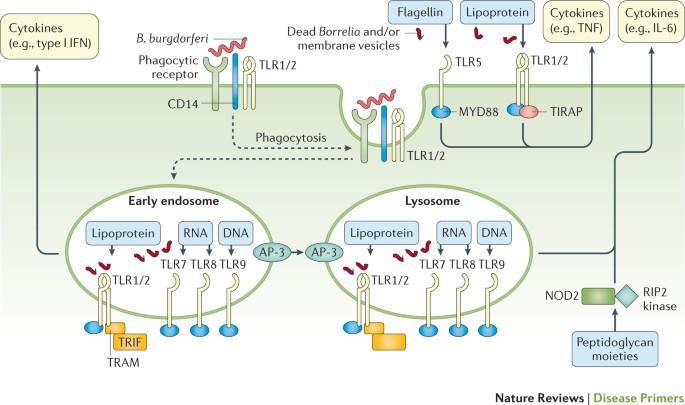
Borrelia lipoproteins and other microbial components activate pattern-recognition receptors, including Toll-like receptors, producing inflammatory signaling. This contributes to recruitment and activation of macrophages, neutrophils and other innate immune cells.
Reference:
Bockenstedt LK, et al. Immune Response to Borrelia: Lessons from Lyme Disease Spirochetes. 2021.
Increased Pro-Inflammatory Cytokines
Lyme infection can stimulate cytokine networks involving TNF-α, IL-1, IL-6, IFN-γ and other inflammatory mediators. These responses help control infection but can also contribute to tissue inflammation and symptoms.
Reference:
Bockenstedt LK, et al. Immune Response to Borrelia: Lessons from Lyme Disease Spirochetes.
Complement Activation — Followed by Borrelia Complement Evasion
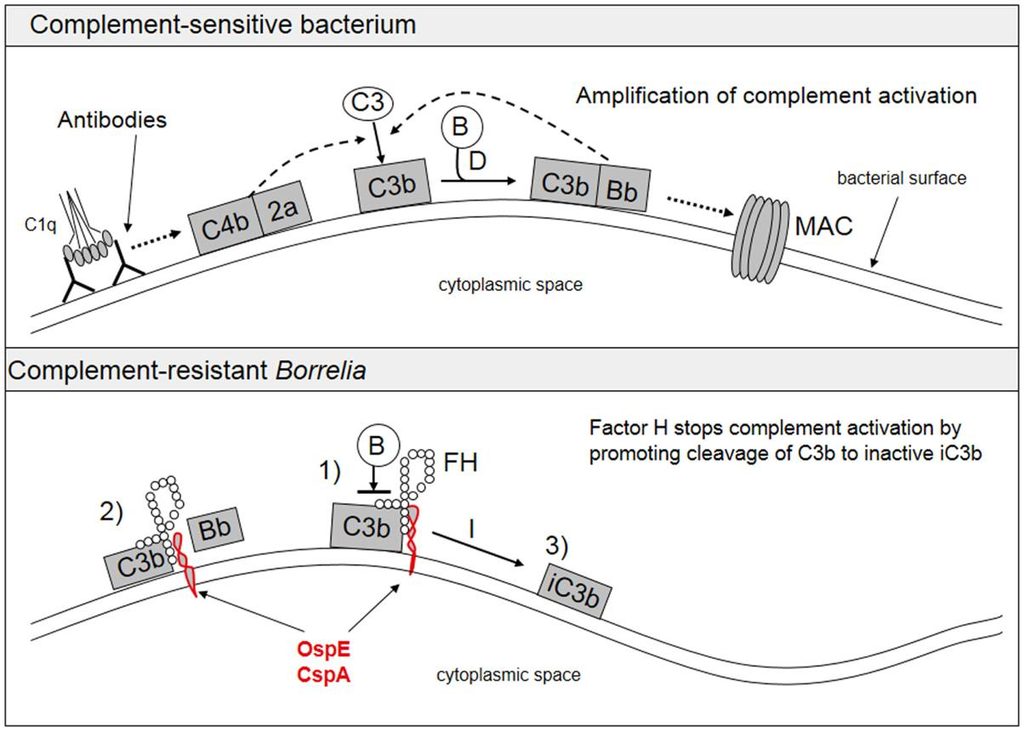
Complement is an important first-line defense against bacteria. Borrelia, however, expresses proteins capable of interacting with complement regulators such as factor H, FHL-1 and C4BP, reducing complement-mediated attack.
Reference:
Coxon et al. Complement Evasion by Lyme Disease Spirochetes. 2020.
Borrelia Can Bind Host Complement Regulators
Proteins including OspE, CspA and CspZ can bind host complement-regulatory proteins. This helps the organism survive in mammalian tissues and fluids.
Reference:
Kraiczy P. Hide and Seek: How Lyme Disease Spirochetes Overcome Complement Attack.
Antigenic Variation
One of the most important immune-evasion mechanisms is alteration of surface antigens. The VlsE/vls locus allows Borrelia to change portions of its surface antigen repertoire, making it harder for antibodies generated earlier in infection to recognize every subsequent population of organisms.
Reference:
From forest floor to doctor’s office: the immunological journey of Borrelia burgdorferi through vertebrate hosts. Frontiers in Immunology. 2026.
Antibody Response Becomes Very Strong
Lyme disease generally produces a substantial antibody response. This is important because Lyme is not primarily characterized by an inability to make antibodies. In later disease, IgG responses can be extensive.
Reference:
Lantos PM, et al. 2020 Guidelines for the Prevention, Diagnosis and Treatment of Lyme Disease. Clinical Infectious Diseases. 2021.
Yet Antibodies Do Not Always Produce Sterilizing Immunity
A major paradox is that a strong antibody response can coexist with persistence of Borrelia. Current research describes adaptive responses that may be non-sterilizing, allowing tissue persistence despite substantial immune activation.
Reference:
From forest floor to doctor’s office: the immunological journey of Borrelia burgdorferi through vertebrate hosts. 2026.
B-Cell Response Is Altered
Recent immunologic work indicates that Borrelia can alter the normal organization and maturation of B-cell responses, including germinal-center responses. This is important because germinal centers normally support high-affinity antibody production and durable B-cell memory.
Reference:
Bridging the gap: Insights in the immunopathology of Lyme borreliosis.
B-Cell Memory Can Be Impaired or Dysregulated
Some studies indicate abnormalities in long-term B-cell memory and antibody responses. This is an active research area, and it should not be interpreted as universal immune deficiency in every patient with Lyme disease.
Reference:
Bridging the gap: Insights in the immunopathology of Lyme borreliosis.
T-Helper Responses Change
Lyme disease involves activation of T-helper pathways, particularly Th1-associated inflammatory responses during early infection. Th17-related responses have also been investigated, particularly in inflammatory manifestations.
Reference:
Bridging the gap: Insights in the immunopathology of Lyme borreliosis.
IFN-γ–Associated Cellular Immunity
Interferon-γ is part of the cellular immune response to intracellular and extracellular microbial challenges and is involved in the inflammatory response to Borrelia. The precise effect varies according to tissue and disease stage.
Reference:
Bockenstedt LK, et al. Immune Response to Borrelia: Lessons from Lyme Disease Spirochetes.
Tissue-Specific Immune Responses Develop
The immune response isn’t identical throughout the body. Borrelia can occupy different tissue environments, and immune-cell recruitment and inflammatory signaling differ between skin, joints, heart and nervous system.
Reference:
Bockenstedt LK, et al.
Chemokine Signaling Changes
Chemokines help determine which immune cells migrate into infected tissues. Lyme infection alters these signaling networks, contributing to leukocyte recruitment and, in some tissues, inflammation-associated pathology.
Reference:
Bridging the gap: Insights in the immunopathology of Lyme borreliosis.
Macrophages Are Activated
Macrophages participate in recognition, phagocytosis and inflammatory signaling against Borrelia. They can help control organism burden but also contribute to inflammatory tissue injury.
Reference:
Bockenstedt LK, et al.
Neutrophils Are Recruited
Borrelia-associated inflammatory signaling can recruit neutrophils and other leukocytes to infected tissues, particularly during early inflammatory responses.
Reference:
Bockenstedt LK, et al.
The Tick Saliva Changes the Initial Immune Environment
This is important and sometimes overlooked. The Ixodes tick itself injects saliva containing immunomodulatory molecules. These can suppress or alter local immune responses at the bite site, facilitating initial transmission and establishment of Borrelia infection.
Reference:
Schuijt TJ, et al. Reviews of tick saliva-mediated immune modulation. See discussion summarized in Borrelia immune-evasion literature.
Borrelia Can Modify Antigen Presentation
Recent reviews describe effects on pathways involved in antigen presentation, including MHC-II and IFN-γ-associated signaling. This could influence how effectively adaptive immunity is coordinated, although the precise mechanisms and clinical significance remain active research areas.
Reference:
Borrelia burgdorferi sensu lato Employs Several Escape Mechanisms to Bypass the Human Defense System. 2026.
Immune Regulatory Mechanisms Increase
The host must prevent uncontrolled inflammation. Regulatory pathways—including regulatory T-cell and other immune-regulatory mechanisms—can therefore become important during infection. These pathways may limit tissue damage but can potentially reduce pathogen-clearing responses.
Reference:
Bockenstedt LK, et al.
Inflammation Can Continue After the Organism Is Controlled
A key distinction is between active infection and post-infectious inflammation. The immune system can continue responding to inflammatory stimuli after microbial burden has fallen. The IDSA/AAN/ACR guideline specifically recognizes that antibody responses can persist for years or decades after eradication, so antibody positivity by itself does not establish ongoing infection.
Reference:
Lantos PM, et al. Clinical Practice Guidelines for the Prevention, Diagnosis and Treatment of Lyme Disease.
Lyme Arthritis Can Involve Immune-Mediated Pathology
Lyme arthritis is not simply a matter of bacteria physically occupying a joint. Immune-cell infiltration and prolonged inflammatory signaling contribute to the joint pathology.
Reference:
Bridging the gap: Insights in the immunopathology of Lyme borreliosis.
The Big Picture
The most useful way to conceptualize Lyme immunology is:
BORRELIA ENTERS → INNATE IMMUNITY ACTIVATES → COMPLEMENT + MACROPHAGES + NEUTROPHILS RESPOND → B CELLS/T CELLS ACTIVATE → ANTIBODIES RISE → BORRELIA USES COMPLEMENT EVASION + ANTIGENIC VARIATION + TISSUE RESIDENCY → IMMUNE RESPONSE CONTINUES → INFLAMMATION AND IMMUNE REGULATION BECOME IMPORTANT.
This means “immune suppression” is too simple a description. Lyme disease involves simultaneous immune activation, immune regulation, immune evasion and, in some settings, dysregulated adaptive responses.
Particularly Important Immune Mechanisms for a Deeper Lyme/Borrelia Table
TLR2/TLR1 signaling
Complement C3/C5 pathways
Factor H/FHL-1 acquisition
CspA/CspZ/OspE
BBK32
VlsE antigenic variation
B-cell/germinal-center responses
IgM → IgG evolution
Th1/IFN-γ
Th17/IL-17
Regulatory T cells
Macrophage activation
Neutrophil recruitment
Chemokine signaling
MHC-II/antigen presentation
Tick-saliva immunomodulation
Tissue-specific immune responses
Immune-complex/complement activity
Post-infectious inflammatory responses
Failure of sterilizing immunity
Big References
- Bockenstedt LK, et al. — Immune Response to Borrelia: Lessons from Lyme Disease Spirochetes. 2021.
Comprehensive review of innate immunity, adaptive immunity, persistence and immune evasion. - Lantos PM, et al. — 2020 Guidelines for the Prevention, Diagnosis and Treatment of Lyme Disease. Clinical Infectious Diseases. 2021;72:e1-e48.
Major evidence-based clinical guideline from IDSA/AAN/ACR. - Kraiczy P. — Hide and Seek: How Lyme Disease Spirochetes Overcome Complement Attack.
Detailed review of complement evasion mechanisms. - Complement Evasion by Lyme Disease Spirochetes. 2020.
Reviews Borrelia interactions with complement regulators and complement pathways. - Bridging the gap: Insights in the immunopathology of Lyme borreliosis.
Reviews cytokines, Th1/Th17 responses, B-cell abnormalities, autoimmunity and tissue-specific immunopathology. - From forest floor to doctor’s office: the immunological journey of Borrelia burgdorferi through vertebrate hosts. Frontiers in Immunology. 2026.
Recent synthesis incorporating single-cell, spatial and systems-immunology findings, including antigenic variation, complement evasion, germinal-center disruption and non-sterilizing adaptive responses. - Borrelia burgdorferi sensu lato Employs Several Escape Mechanisms to Bypass the Human Defense System. 2026.
Recent review of antigen presentation, immune evasion, antigenic variation and adaptive immune dysregulation.